
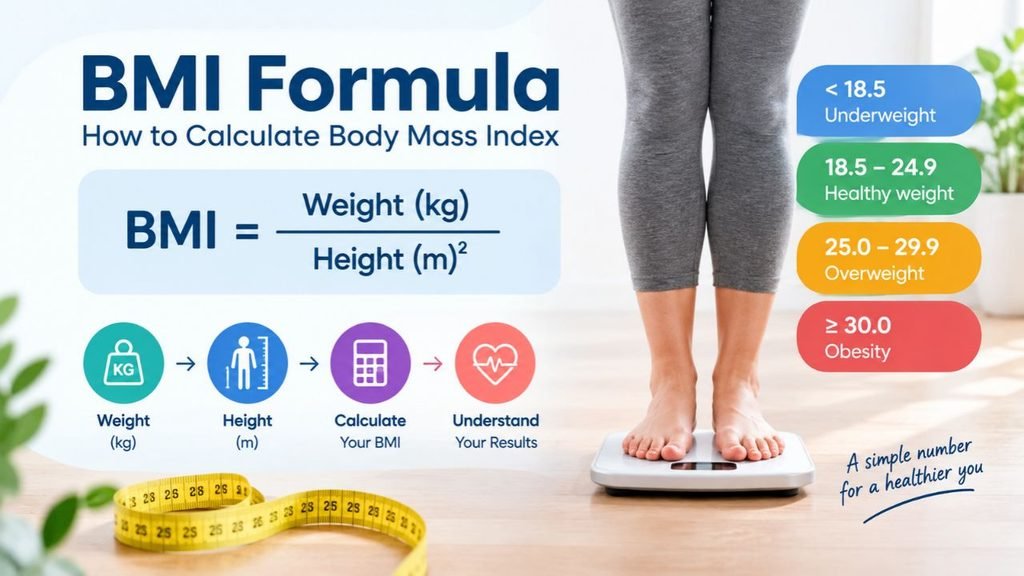
BMI Formula = Weight (kg) / Height^2 (m). BMI is often utilized for screening purposes to categorize weight as a function of height. For adults, the standard way to calculate it is weight in kg divided by height in meters squared. You can estimate BMI in pounds and inches with a conversion factor of 703.
BMI Formula = Weight (kg) ÷ [Height (m) × Height (m)]
For example, a person weighing 70 kg and measuring 1.75 meters tall has a BMI of approximately 22.9. This article explains how the BMI calculation works, how to calculate it manually, which BMI categories are commonly used for adults, and why BMI should not be treated as a complete measure of health.
What Is the BMI Formula?
The BMI formula, also called the body mass index formula, compares a person’s weight with their height. The standard metric equation is:
BMI = Weight (kg) ÷ Height² (m²)
In simple terms, you divide your weight in kilograms by your height in meters multiplied by itself.
| Measurement | Required Unit |
| Weight | Kilograms (kg) |
| Height | Meters (m) |
| Result | BMI in kg/m² |
The CDC uses this formula for calculating BMI for adults as well as for calculating the initial BMI value used in children and teenagers before it is interpreted according to age and sex.
How to Calculate BMI Step by Step
If you want to calculate BMI manually, follow these steps:
- Measure your weight in kilograms.
- Measure your height in meters.
- Multiply your height by itself.
- Divide your weight by the squared height.
- Compare the result with the appropriate BMI categories.
Example
Suppose a person weighs 70 kg and is 1.75 m tall.
BMI = 70 ÷ (1.75 × 1.75)
BMI = 70 ÷ 3.0625
BMI = 22.86
Rounded to one decimal place, the BMI is 22.9.
For adults, a BMI from 18.5 to less than 25 falls within the CDC’s healthy-weight category. However, BMI is a screening measure and should be considered alongside other health information.
BMI Formula in kg and cm
Many people measure their height in centimeters rather than meters. If your weight is in kilograms and height is in centimeters, you can use this alternative BMI formula in kg and cm:
BMI = [Weight (kg) ÷ Height (cm) ÷ Height (cm)] × 10,000
The 10,000 factor is used because 1 meter equals 100 centimeters.
Example Using kg and cm
Suppose:
- Weight = 70 kg
- Height = 175 cm
The calculation is:
BMI = (70 ÷ 175 ÷ 175) × 10,000
BMI = 22.86
So, the person’s BMI is approximately 22.9.
The CDC provides both the meter-based formula and this centimeter-based version.
BMI Formula in Pounds and Inches
If you use U.S. customary measurements, you can calculate BMI with weight in pounds and height in inches.
The standard BMI formula in pounds and inches is:
BMI = [Weight (lb) ÷ Height² (in²)] × 703
In other words, multiply your weight in pounds by 703 and then divide that number by your height in inches squared.
Example
Suppose a person weighs 154 lb and is 68 inches tall.
BMI = (154 × 703) ÷ (68 × 68)
BMI = 108,262 ÷ 4,624
BMI ≈ 23.4
This is another way of performing the same basic body mass index calculation when using imperial units.
BMI Calculation Examples
Here are two simple examples showing how to calculate BMI using the metric formula.
| Weight | Height | Calculation | BMI |
| 60 kg | 1.65 m | 60 ÷ (1.65 × 1.65) | 22 |
| 85 kg | 1.80 m | 85 ÷ (1.80 × 1.80) | 26.2 |
These examples demonstrate the BMI weight and height formula. A BMI number by itself does not diagnose a medical condition.
BMI Categories for Adults
For adults aged 20 and older, the CDC uses the following BMI categories:
| BMI Range | Category |
| Below 18.5 | Underweight |
| 18.5 to less than 25 | Healthy Weight |
| 25 to less than 30 | Overweight |
| 30 or greater | Obesity |
| 30 to less than 35 | Class 1 Obesity |
| 35 to less than 40 | Class 2 Obesity |
| 40 or greater | Class 3 Obesity |
The commonly cited normal BMI range is approximately 18.5 to 24.9, while the CDC describes this range as healthy weight. WHO similarly classifies adult BMI below 18.5 as underweight, 18.5–24.9 as normal weight, 25.0–29.9 as pre-obesity, and 30 or higher as obesity.
BMI Formula for Men and Women
The standard adult BMI formula for men and women is the same:
BMI = Weight (kg) ÷ Height² (m²)
The basic calculation does not change based on whether an adult is male or female. However, BMI does not provide information about body composition, and individual health assessment may require other measurements and information.
The CDC states that adult BMI categories for people 20 and older are based on BMI regardless of age, sex, or race.
BMI Formula for Children and Teenagers
Children and teenagers should not be interpreted using the standard adult BMI categories.
For children and teens aged 2 through 19, BMI is calculated from weight and height, but the result is interpreted using BMI-for-age percentiles that are specific to age and sex. This is necessary because children and teenagers are still growing.
| BMI-for-Age Percentile | Category |
| Below 5th percentile | Underweight |
| 5th to less than 85th percentile | Healthy Weight |
| 85th to less than 95th percentile | Overweight |
| 95th percentile or greater | Obesity |
Therefore, parents should not take a child’s BMI and compare it directly with the adult BMI chart. A pediatric healthcare professional can help interpret a child’s BMI-for-age result.
How to Interpret Your BMI Result
A BMI result gives you a numerical measure of weight relative to height. For adults, it can be used to place someone into a broad screening category.
However, BMI does not directly measure body fat. Two people can have the same BMI while having different amounts of muscle and body fat.
Factors that may be relevant when interpreting BMI include:
- Muscle mass
- Body composition
- Age
- Sex
- Pregnancy
- Overall health
- Lifestyle and physical activity
- Medical history
The CDC describes BMI as one potential health indicator and a screening measure, rather than a diagnostic tool.
Is BMI an Accurate Measure of Health?
BMI can be helpful because it is a quick and easy way to assess weight in relation to height. In public health and clinical settings, it is commonly used for screening.
However, it has limitations. Because BMI is not a direct measure of body fat versus lean mass, it may not fully describe someone’s adiposity. BMI is referred to by WHO as a surrogate marker of fatness, and other measurements such waist circumference are considered useful for obesity assessment [55].
Because of this, a BMI result should be viewed alongside other relevant health metrics and not used in isolation to help diagnose if someone is healthy or unhealthy.
BMI Formula vs BMI Calculator
A BMI calculator simply performs the same mathematical calculation automatically.
| Method | How It Works |
| Manual BMI calculation | You enter the formula yourself |
| BMI calculator | The tool calculates the result automatically |
| Metric formula | Uses kg and meters |
| Imperial formula | Uses pounds and inches |
For adults, a calculator should produce the same result as a manual calculation when the height and weight measurements and units are entered correctly.
The CDC provides separate BMI calculators for adults and for children and teens.
Common Mistakes When Calculating BMI
Several simple measurement or unit errors can produce an incorrect result.
1. Using centimeters as meters
If your height is 175 cm, enter it as 1.75 m when using the standard metric formula.
2. Forgetting to square height
The formula uses height², meaning height must be multiplied by itself.
3. Mixing measurement units
Do not combine kilograms with a formula designed for pounds and inches. Choose the correct formula for your units.
4. Applying adult categories to children
Children and teenagers require BMI-for-age interpretation based on age and sex.
5. Treating BMI as a diagnosis
BMI is a screening measure, not a diagnosis of disease. Other health information may be needed to understand an individual’s health more completely.
Read More: What is Excel || I Love PDF to Excel
FAQs About BMI Formula
What is the BMI formula?
The standard metric BMI Formula is:
BMI = Weight (kg) ÷ Height² (m²)
How do I calculate BMI from height and weight?
Convert your weight to kilograms and height to meters. Square the height and divide your weight by that number.
What is the BMI formula in kg and cm?
Use:
BMI = [Weight (kg) ÷ Height (cm) ÷ Height (cm)] × 10,000
How do I calculate BMI in pounds and inches?
Use:
BMI = [Weight (lb) ÷ Height² (in²)] × 703
Is the BMI formula the same for men and women?
Yes. The standard adult BMI calculation is the same for men and women.
What is a normal BMI range for adults?
A BMI of 18.5 to less than 25 is classified as healthy weight by the CDC for adults aged 20 and older.
Is BMI a reliable measure of health?
BMI is useful as a screening measure, but it does not directly measure body fat or provide a complete picture of individual health.
Can BMI be calculated manually?
Yes. You only need an accurate weight and height measurement and the appropriate BMI formula.
Should children use the same BMI categories as adults?
No. Children and teenagers aged 2–19 are evaluated using BMI-for-age percentiles based on age and sex.
What does a BMI number tell you?
For adults, BMI indicates how a person’s weight compares with their height and places the result into a broad screening category. It should be interpreted alongside other relevant health information.
Final Thoughts
BMI has a simple formula – Weight in kg/(Height in metre)^2. If you are using pounds and inches: (Weight / height²) × 703 These equations allow the calculation of BMI to be performed with a simple manual process or using a body mass index calculator.
For adult individuals, BMI categories could serve as a convenient screening reference where the relationship between excess weight and disease risk is at its strongest; however, it does not predict body composition or overall health. In children and teenagers, BMI must be interpreted in the context of age – and sex the appropriate cutoffs for obesity are not established based on adult values.
When a BMI result prompts questions about health, the most useful information can be found in talking to an appropriate healthcare provider rather than relying on numbers alone.